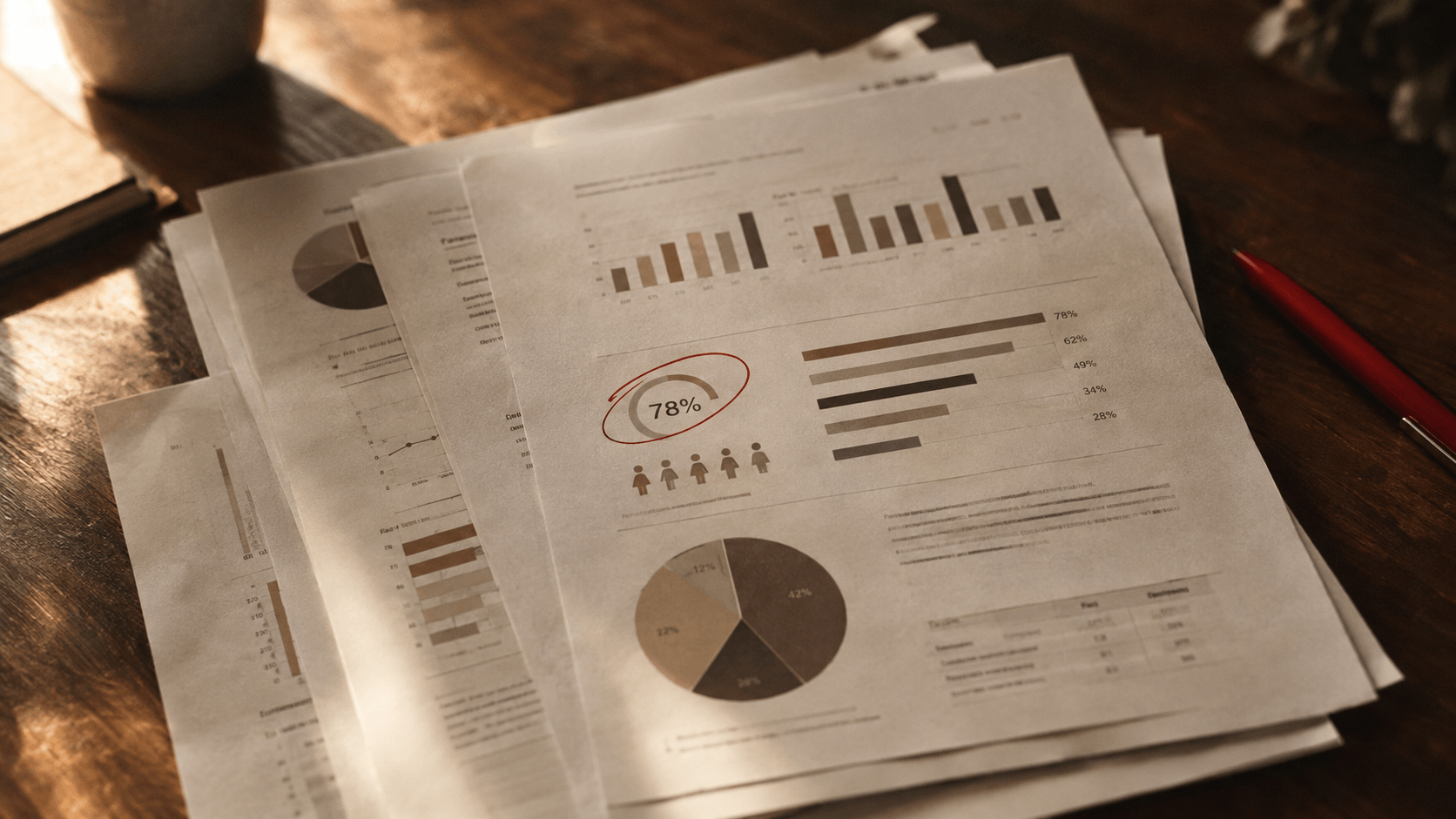
Ask how many Australian small businesses are using AI and you’ll get an answer anywhere from 11 percent to 44 percent, and both people making the claim will say it with a straight face. The Australian Bureau of Statistics puts workplace AI use at around 12 percent across all businesses, drawn from nearly 7,000 companies surveyed between October 2025 and February 2026. The National AI Centre’s own SME tracker says 44 percent. MYOB says 40. A card transaction study by Weel, looking at what businesses actually paid for rather than what they said in a survey, landed at 30.8 percent.
None of these numbers are wrong. They’re measuring different things. The ABS asks about AI use inside a formal workplace technology framework, the kind of question that gets a considered no from an owner who tried ChatGPT twice and never thought of it as “using AI in the workplace.” The vendor trackers ask something much looser, closer to “have you used an AI tool at all,” which catches a lot more casual, unstructured use. Neither approach is dishonest. They’re simply not asking the same question.
The number worth paying attention to sits inside the ABS data rather than at the top of it. Businesses actively working on innovation, new products, new processes, anything beyond running the same operation the same way, adopted AI at close to five times the rate of businesses that weren’t innovating at all. Size matters too. Large businesses reported AI use at 35 percent, up from 9 in 2021 to 2022. Medium businesses sat at 22 percent, up from 3. Small and micro businesses trailed at around 11 percent.
That gap between small and medium isn’t really about AI being unsuited to smaller operations. It tracks with something far more ordinary: a medium sized business usually has someone whose job includes evaluating new tools, and a small one usually doesn’t. The adoption curve is following headcount and available time, not appetite for the technology itself.
Reading the headline numbers the wrong way causes two opposite mistakes. A business owner who sees “70 percent of businesses use AI” in a press release can feel behind and buy a tool out of anxiety rather than need. A business owner who sees the ABS’s more conservative 12 percent can dismiss the whole category as hype nobody’s actually using. Neither read is particularly useful, because neither is really a benchmark you should be measuring yourself against.
What actually predicts whether AI does anything for a small business isn’t which survey you believe. It’s whether there’s a specific, repeatable problem it would solve, the same test you’d apply to any other tool. The businesses getting real use out of it aren’t chasing AI because it’s AI, they’re the ones already in the habit of changing how they work, who picked up an AI tool the way they’d pick up any other process improvement, because it fixed something concrete. That’s roughly how we think about it too. It’s genuinely useful for the repeatable, boring parts of a project, drafting variations, checking a spec against requirements, summarising research, and far less useful as a substitute for judgement on the parts that actually decide whether a project works. The businesses the data agrees with are the ones treating it as a habit rather than a headline.
The tool followed the habit, not the other way round.